Magazine about large electronic LED screens and signs
LED screens and application
English Spanish German French Russian Site search E-mail
Main Magazine Types of large screens Application of large screens
How to choose type & size of large screen? Prices of large screens About authors

Issue #7/2007

Network of video screens by Alive Advertising in South Africa

In this issue we publish the article written specially for our magazine by Itz Arenstein, CEO of Alive Advertising which owns network of video LED screens in South Africa. He shares with our readers with ups and downs his company has been living through for last 10 years to build won network after all.

Itz Arenstein
(14.07.2007)

Alive Advertising was established in 1997 the initial concept was to enable the small business to advertise at high profile sites at a price more affordable than the static billboard.

In 1997 in South Africa and I think in the rest of the world, there was no commercial application other than scoreboards. This was the 1st venture into electronic billboard advertising, at that time the only technology available was RG and this offered only 4 colours namely, red, green and if used together yellow also when switched off black.

As we were the first to develop this form of advertising in South Africa, we had to experiment with various tricks of using fonts, low resolution graphics, how many slots to a cycle what length the cycle should be and most importantly, what price we could sell for. I am sure the pioneers of Electronic Billboard advertising in different countries experienced the same frustrations and joys we went thru.

We soon realised in order to make a success of the venture, we could not survive with only 1 site, the larger corporations required multiple locations to make it worth their while to utilise our media. Within 3 months of erecting our first Screen, we had applied for 3 additional sites. As this was a new media, our target was to erect screens at high profile traffic light controlled intersections, at that time, we had very little problems with receiving permission from the local council.

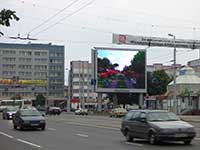
Video screen by Alive Advertising Video screen by Alive Advertising
Rosebank M1 South

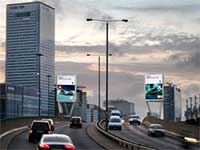
It took us 4 years to establish a network of 14 sites in Johannesburg, we were also able to get permission to erect 2 screens over our local Motorway, to our knowledge these are the only screens located over a major highway anywhere in the world. (The daily average traffic count of vehicles is in excess of 180,000 in one direction) 50% of the advertising space is given to the council for pertinent road messages, as well as a programme we developed for emergency messages to inform the motorist should there be an accident on the highway.

We decided to erect a screen in Cape Town in 2000, the idea was to explore setting up screens far from our base, we found that it was very difficult to control sales staff and eventually gave up on local sales staff and all sales are generated from Johannesburg.

We have had competition from various entrepreneurs who have tried to enter the market, unfortunately the cost of an Electronic Billboard in South Africa (local currency is 7 to US$1) has restricted many potential entrepreneurs from entering, those that have, have entered as a sideline to their own businesses, this does not work as our industry is a full time business and we eventually took over most of their sites.

The passage of time has brought about various restrictions from the authorities who are trying to clamp down on the proliferation of static billboards; the fallout of the various amended bye laws has also affected our electronic media. We now have to erect our screens a minimum of 50 meters from any intersection, in addition each new application must have an environmental impact study (which is expensive) and this too limits any new entrepreneur from entering our media.

Technically, we have standardised on a screen size of 4.5 x 2.5 meters, which is 11.25 sq meters, compared to overseas electronic billboards this is small, but when viewed from 100 meters, the size is right for our market. The other reasons for this size is cost, to purchase a screen, costs 7 times more due to the dollar exchange rate, and we cannot sell for dollars.

Video screen by Alive Advertising Video screen by Alive Advertising
Balfour Park Ashford House

When we first started our business we started with a 39 mm pitch and since inception, we have upgraded 6 times as the technology improved, today our high profile screens are 20 mm pitch, we still have our first RG screen running at a very low but necessary location. All screens are controlled from our office, communication is via ISDN lines, we employ 5 graphic artists, a dedicated person to do the loading and a full time technician to look after the screens.

How do we see the future, expansion will be via partnerships, eventually we will have a global business where our advertisers will require to advertise on screens in all countries where they have a presence, we will need to form relationships with as many companies in our industry so that we can offer clients the option of advertising outside of local borders. The future for outdoor advertising is Electronic Billboards, it is more labour intensive than static billboards, but catches the viewers eye with a far better effect.

Unfortunately, after 10 years, we are now slowly making headway into advertising agencies, but it is an upward battle. Most of our business has been from client direct, I am wondering if any other media owners have had the same difficulty with agencies. We run 4 different cycles of 3 minutes each, this allows us to offer our clients either 480, 240 or 120 spots per day, we also have clients opting for 960 spots per day, each spot is 10 second.


Copyright ©1996-2010 VK
E-mail: screens@screens.ru