Issue #4/2007 Social and Cultural Aspects of Outdoor Video Technology for National and Municipal NetworksUsage of modern information display systems in civic societyAs you all see, we live in the time of informational explosion, when the fastest growing industries are linked with technology that allows to pass information over to the general public in the shortest possible period. These are mass media and advertising, and of course, the most recent additions: the Internet and large outdoor LED screens. The number of TV channels, radiostations, newspapers, magazines is growing. In spite of all limitations, outdoor advertising and billboards are everywhere. Internet resources are increasing exponentially every day. We like to be informed. But a multitude of information creates new problems:
Advertisers are constantly searching for new ways to promote their products and services; authorities are constantly searching for ways to increase efficiency of political campaigns, various social events that include sport, festivities, mass shows. This is exactly what a new technology of “outdoor TV” and “outdoor video” based on large LED screens can deliver. The essential characteristics of this new informational carriers are:
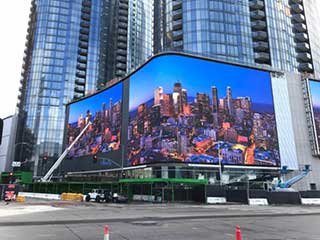
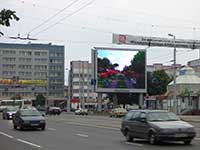
Practically unheard of just a few years ago, the LED screens are becoming a key element in the government, regional and urban informational infrastructure. Separately standing screens are now joined into networks, thus, increasing the efficiency of this new technology even further. First city networks appeared back in 1998-99 in San-Paolo (Brasil), Johanesburg (Republic of South Africa), San Francisco (USA), Moscow (Russia). Today there are three tendencies that can describe development of large screen technology in city environment: Individual installation of LED screens with no regard for urban landscape, architectural peculiarities of nearby territory, effect on citizens. There are plenty of examples in Europe, USA and Russia. 2) Substitution of existing advertising outdoor structures for sophisticated screens. The best examples can be seen in Shanghai (China), a network of Clear Channel in New York (USA), and Moscow (Russia).
Both tendencies are mostly related with advertising application of LED screens. Third tendency is to use large LED screens not only for outdoor advertising but as a large scale public address system in case of various massive events: terrorist threats, floods and other emergencies, as informational support systems in public campaigns, or festivities. It is the third tendency that will be essential in future. Because it allows to reasonably combine commercial interests of advertisers and interests of a civic society, as represented by federal and municipal authorities. Russia is the first country where large LED screens were supported on the governmental level, where large outdoor LED screens were included into the program of public address, where importance of influence of screens on general public was recognized on the state level. In October 2004, the Government Decree #1327 was issued that listed all possible technical mass media measures that have to be taken to keep population well-informed in case of emergency. This significantly pushed forward programs developing integrated informational solutions in the out-of-home environment. Problems and factors that limit introduction of such systems in practiceAt the same time, there are numerous problems that prevent LED screens from becoming widely used:
Here we should remind ourselves that screens have appeared only recently and still are one of the most complex technical areas in modern electronic and digital equipment. Screens today – can be compared to PCs in the 80-ies when 386-486 processors were considered state-of-the-art technology. However, breakthroughs are near at hand:
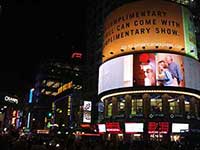
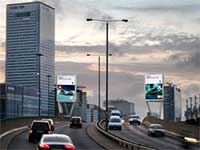
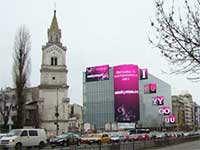
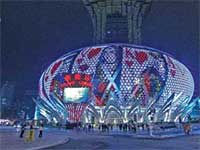
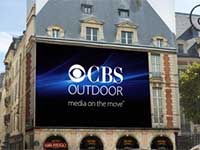
Modern solutions for incorporating LED technology into architectural projects and city landscapeIt’s a great pleasure for me to see that now the status of LED screens has risen so high as to justify an international forum like the one we are having today that addresses incorporation of screens into the urban environment and ascribes new interactive possibilities to screens. Here are some examples, probably well know to this audience but which once again stress how harmonious or incongruous maybe the presence of LED screens on the streets of out towns. Urban environment is tough on people and screens may do much to alleviate the stress, move away from the concept of “concrete jungles” into a pleasant, brightly-lit and interactive cities.
A few words about content that appears on screens and formats of presenting information
|
||||||||||||||||||||||||||||||||||||||||||||
![]() |
Here is the place for an interesting example: a creative experiment of the German artist Fred Froelich whose special format clips were displayed for a month on all CityVision screens in Russia in 27 cities and which helped to drastically increase public approval and awareness of screens as a useful urban mass media. The clips consisted of 25 words that are associated exclusively with positive images. Each word had a numerical index calculated by a special formula. The words appeared on screens as bright red letters on black background, and their numerical indices – as black numbers on red background. Until the campaign was completed no explanations were given in the press. At the same time the campaign created quite a stir in public thinking in each of 27 cities. |
Another interesting and innovative approach to advertising was demonstrated by a Hong-Kong based company JM Network. Unlike other advertisers with traditional short advertising blocks of 6 or 10 minutes, the company introduced commercials of arbitrary length from 5 seconds to 7 minutes and a 10-minute newsreel. The total loop may last between 30 to 60 minutes and always begins with live News broadcast at the beginning of each block.
![]() |
![]() |
| LED screen in Hong-Kong on Jordan Road that works in the JM Network | |
Their approach to the format of advertising clips is also worth mentioning. The format of frames changes from 9:16 to 3:4 with various linear dimensions. This helps utilize the screen area better. The commercials maybe fully dynamic video clips or half-static (with minimum dynamic) with or without sound.
![]() |
![]() |
| LED screen in Hong-Kong on Jordan Road that works in the JM Network | |
By splitting a large LED screen into sections with socially valid information (like news blocks, weather forecasts or displaying of current time) and commercials, the screen owners increase it’s attractiveness to the public. Consequently, the price of advertising time on such screens significantly grows.
![]() |
![]() |
| LED screen in Hong-Kong on Jordan Road that works in the JM Network | |
As a result, no matter how often people pass by and look at the screen, they never get used or get tired of it. The screen transformed a typical street in the maze of “modern concrete jungle” into a place of light and joy.
![]() |
![]() |
| LED screen in a department store in Taipei (Taiwan) | |
![]() |
| LED screen in a department store (Hong-Kong) |