Magazine about large electronic LED screens and signs
English Spanish German French Russian Site search E-mail
Main Magazine Types of large screens Application of large screens
How to choose type & size of large screen? Prices of large screens About authors

How to choose the type & size of large electronic screen / sign / display?

1. Large electronic system for outdoor advertising

2. Large electronic system for concert & sport (at open stadiums) usage

3.Large electronic signboards for advertising of own goods & services and simultaneously for common advertising usage

4. Large electronic system for indoor football, athletics, hockey stadiums, tennis courts, basketball & volleyball grounds, swimming pools

We are receiving many letters (from Russia and from abroad) with requests to prompt which model of the screen / sign / display is the most appropriate for their working conditions considering optimum “efficiency / price” ratio.

To tell the truth, the choice of the system depends on many criteria and circumstances, and we would like to publish a series of articles devoted to the various approaches to the problem of "optimal choice".

The basic problems are:

1. For what purposes - image, advertising, informational system (for example, a city channel of outdoor TV or outdoor video), for concerts, sports measures or pre-election (political) actions, etc.

2. Where (in the streets and at squares, in stadiums and concert stages, indoors, etc.) and accordingly under what climatic conditions.

3. In which mode (round-the-clock, evening time...) will the screen work.

4. Whether you plan the recoupment of the system

Let's start with the most difficult and simultaneously the simplest problem

If you need the best electronic sign and recoupment is not a question for you, as if you were choosing an exclusive car that is more expensive than Mercedes 600. In this case you certainly should choose among the newest fullcolor led systems of cluster type or the newest REAR-projection laser systems and the newest JVC REAR-projection systems on the basis of projectors. You should be ready to pay 30.000-40.000$ for each square meter, plus 100-200.000$ more for computer and video equipment and 200.000-1 million $ for 1 year of service (read more detailed information about these systems in release 6 (October 12). The manufacturers can adapt these systems for round-the-clock operation in adverse weather conditions for an extra thousand or million dollars. Don't worry - you will get the most advanced system!

Now let us speak about the simplest, but simultaneously the most difficult problem.

There are some demands that are applied to outdoor advertising and the support of large sports competitions, political campaigns & cultural events (shows, concerts). The organizers and the majority of Western, large-scale Russian and CIS advertisers already have developed the basic requirements to what they spend the advertising budgets on.

First of all, it is the scope of audience (or how many people will see this ad)

It is defined by the pedestrians` flow in the place where the electronic sign / screen is located.

- the automobile flow

- the sizes of the area (square) and the number of people gathering at this place during some feast celebration, concert, sports and political events.

  • by “depth and width” of the scope of these flows (i.e. from where the screen and the information can be seen, at what time and during what period of time people and the human flows, including automobile flows, can observe this information). – that means ,
  • by the efficiency of the advertising campaign at a certain place at this carrier.

To answer these questions it is necessary, first of all, to determine the place where the screen will be located and then to decide what will be the linear sizes (proceeding from the location characteristics of the screen) because they determine the amount of people who will see the information on the screen.

It is necessary to take into account the following human and purely visual concepts -

When we come to an oculist, we look at small 10-1sm letters from a distance of 3m. The majority of people can see 5sm letters without any difficulty. And if we want people to see the information (minimum 3 text lines) from a distance of about 100-150m, the size of your screen should be no less than 4m80sm, and it should be more than 4m above the ground. If the100-150m area is not limited with the trees and buildings at its perimeter and continues as far as 300-600m with a central highway or a street, the vertical size of the sign should be about 9meters, and it should be more than 5-6m above the ground. As for Poklonnaya hill in Moscow, for example, the square and the scene are at the distance of 200m from the sign, and the central avenue continues as far as 1 km. Thus it is necessary to provide a screen no less than 12m in height and to place it 7-9m above the ground.

The horizontal of the screen depends on the typical TV correlation : close to 3x4 or 9x12 (i.e. 3x4m, 6x8m, 9x12m, 12x16m, etc.).

In general, our eye perception & distance (from which we can perceive visual information) characteristics are the most important criteria for the calculation of the amount of people who will see the ad passing by or taking part in meetings. It is important that the screen should be visible not as a single point - it should be readable. So the linear size is of great significance.

Thus it is possible to make a table depicting the correlation between the linear sizes & the area of effective perception of the information. The linear sizes of an electronic screen - the area of effective influence

Linear sizes of the electronic screen (height above the ground) Minimal distance Maximal distance Optimal distance
3x 4m (>3 m) 5 m 30m 10-20m
4x6m or 5x7, 5m (>4or5m) 5 m 50m 10-30m
6x8m (>5or7m) 10m 50-70m 20-50m
9x12m (>6or9m) 10m 150-200m 20-100m
12x16m (>6or12m) 15m 200-300m 40-200m

This table is not an absolute dogma, since the parameters depend on a concrete place - but on the average it is characteristic of the fact that the bigger are the linear sizes - the greater is the distance & the area of informative (both text and video) perception and the longer is the time of perception – thus the greater is the audience apprehending this information.

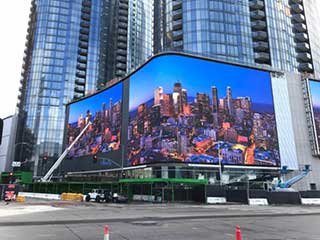
When we came to these conclusions it has become clear why several huge electronic signs / screens by the size of 9x12m and 12x16m appeared in America at Times Square during the latest 2-3 years.

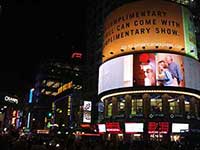
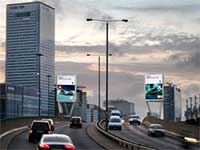
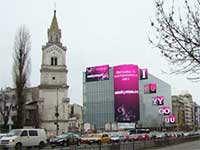
Large electronic lamp screen at Times Square Large electronic screen at stadium Large electronic AT&T screen
The size of the screen is about 9x12m The size of the screen is about 9x12m The size of the screen is about 12x16m
Huge electronic U2 concert screen Large electronic led screen of Spice Girls Large electronic screen of Rolling Stones
  The size of the screen is about 9x12m  

Besides, the angle of horizontal view greatly influences the quantity of the people that will see it (though this characteristic should be adhered to the location of the screen).

I.e. if your square is not only more than 50-100m in length, but also has the same or larger width; the angle of the horizontal view should be 80-160 degrees. If your sign is placed on a highway and is not seen from the sides (for example, in the Stary Arbat street in Moscow), the angle of 30-40 degrees can be enough.

Now let`s talk about characteristics influencing the quality

  • Brightness, contrast and color palette support

These characteristics are important first of all if it is planned to use an electronic sign in daytime and if it is impossible to prevent the screen from direct sunbeams.

In this case you should choose a system with brightness of no less than 10 000 cand/m2 and even 25 000 cand/m2.

But if the screen does not face direct sunbeams (for example it is installed on a porch of a building, and the building protects it from the sun), the brightness of 5 000 cand/m2 could be enough.

  • resolution in pixels

It is a very interesting technical criterion -

Our eyesight can`t perceive & apprehend small type (even if the resolution of the screen is the greatest) even from a distance of optimum recognition. The linear size of the screen will be so small that you need to have better than normal eyesight or use binoculars to see at least something. – thus, you will simply waste your money.

Besides, it is necessary to take into account one more purely technical detail. All electronic signs / screens as newest lamp or led or gas-discharging are digital initially, and any television signal - PAL, SECAM with 240-320 lines - is analog, not pixel (digital). Even some engineers mix these things up. Only 120 of them are transferred, and others are noise. Therefore there appeared such a concept as "sufficient resolution" - about 120x160 pixels - which allows you to transfer the majority of TV signals. I.e. the better is the resolution of the large outdoor electronic screen, the less work is spent on transformation and the better is the quality. On the other hand, if it is 100.000 or 500.000$ more for you, maybe it is reasonable to limit your demands with "sufficient” or even smaller resolution. It is proved on practice (Moscow, Omsk, Novosibirsk) that it is quite possible to work even with resolutions of 60x80 or 70x100. Linear sizes, the area of vision & the scope of the audience are much more important for getting advertising tenders.

But still optimal resolution should be 120x160 pixels.

  • Operational, climatic characteristics and modes of operation of the system

Repair-ability

It is a main characteristic. It is very important in Russia and CIS whether there is a service center or company that can make repairs or replace parts (as Western companies providing guarantees for everything). Therefore it is necessary to notice not only WHO guarantees WHAT, but also HOW these guarantees are carried out.

Thus it is better if the operating of the system is not so complicated & if the system is quite repair-able (not to turn ad-business into engineering research).

  • Temperature mode

It is better in Russia and the countries of CIS if the temperature varies from -50 to +50C.

  • Round-the-clock mode.

It is optional, but if the system is reliable and repair-able, then it usually provides this mode also.

The screen should consist of modules & should be mobile (for sports, cultural & political campaigns)

Direct broadcasting (for sports, cultural, political campaigns)

Now, as we started providing the basic characteristics, we can choose among various types taking into account price criteria applying to concrete place & situation.

It is necessary to find a compromise between the linear sizes, brightness, "sufficient resolution " & the type and cost of the system.

Thus it is necessary to take into account the upgrade-ability of a system. i.e. is it possible to begin with one type (for example not so expensive for a certain linear size, but having insufficient resolution), and then in due course (in one or two years), to upgrade it (for example, only the electronic part) to more accomplished?

The system should be (optimum worldwide criteria)

-about 9x12m, full color, 16 million color palette with "live video" mode support.
-brightness from 10 000 cand/m2 (better from 20 000 cand/m2)
-resolution from 120 to 160 pixels
-round-the-clock mode at -50+ 50C temperature mode, repair-ability (or a warranty service)

But in each concrete case it is necessary to consider the place where your electronic sign is going to be installed.

(to be continued in the next release)

And now one more good news:

By the end of the year (about December, 20) the new prices (in Moscow) for the newest American-Russian full color lamp signs will be introduced - it is expected they will be about 5000$ for 1m2 (instead of 5800$) for the orders of up to 100m2 (i.e. less than 9x12m) and 4500$ for 1m2 for more than 100m2.

The prices for Led screens have not changed yet.


Copyright ©1996-2010 VK
E-mail: screens@screens.ru